Thursday, 17 February 2011

Article for Feb. 22nd."Cashless Society," The Independant


Cashless society by 2012, says Visa chief

By Tim Webb
Sunday, 11 March 2007
Paying for goods with notes and coins could be consigned to history within five years, according to the chief executive of Visa Europe.
Peter Ayliffe said that, by 2012, using credit and debit cards should be cheaper and more convenient than cash.
Some retailers could soon start surcharging customers if they choose to buy products with cash, because of the greater cost of processing these payments, he warned.
Visa Europe briefed the British Retail Consortium last month on new "contactless" cards that can be waved in front of a scanner to make small payments.
However, the consortium dismissed this vision and claimed that card processing fees, which regulators are investigating, are still too high.
One member of the consurtium said that the estimated "interchange" fee charged to retailers amounts to some 4p for each transaction.
Nick Mourant, treasurer at Tesco, said: "There is a duopoly between Mastercard and Visa in the UK. Their setting of fees is anti-competitive."

Article for Feb. 22nd. Study from "Heritage", an American think tank...


Tunisia: Predictably Disastrous Handling by Brussels

Posted February 15th, 2011 at 12:00pm in American Leadership 1Print This Post Print This Post
Harvard University’s Niall Fergusonrecently criticized the Obama Administration for lacking foresight and planning over the events in Egypt. The point of his criticisms of the Administration—and, by extension, the European Union—was illustrated over a year ago in a Heritage Foundation “war game.”
In late 2009, Heritage invited security experts and Washington-based policymakers to “game” a fictional scenario of its own whereby Tunisia was hit with a major earthquake. Significant political and civil unrest followed, accompanied by large numbers of refugees flowing from Tunisia to Italy and Malta.
The exercise was intended to test how well NATO and the EU would respond to such crises, and it proved eerily predictive of current events in North Africa. In Heritage’s simulation, when Tunisia was hit by the fictional earthquake, the EU foreign minister made a number of statements proclaiming leadership of the crisis. The player simulating the role of the U.K. stated that this mission was an opportunity for the EU to demonstrate its much-vaunted ability to project soft power, and the U.S. was happy to see Europeans taking the lead for the crisis.
Although the EU foreign minister worked tirelessly to rally firm peacekeeping and financial contributions from member states for a large-scale European response, she was ultimately unsuccessful. Italy, Malta, and other affected nations were left largely alone to struggle with massive refugee influxes. The EU foreign minister did little more than make a number of political statements and call international conferences. Neither the EU nor the Tunisian government could gain control of the situation, and security in the affected region quickly declined.
Reports also emerged that Islamists were using the situation to migrate into Europe undetected. Italy proved exasperated that its demands for more EU action went ignored. When Heritage announced that a second security crisis had erupted in the Balkans (as has happened in Egypt in real life), the players fell victim to their “one crisis at a time” method of working.
In reality, few European nations had the forces or political will necessary to deal effectively with either crisis, and America failed to play its traditional leadership role, having been assured that the EU was to be taken seriously following the introduction of the Lisbon Treaty.
The Heritage simulation demonstrated that EU assertions of leadership lacked substance—which is exactly what has happened in real life. An estimated 5,000 asylum seekers have reportedly arrived on the Italian island of Lampedusa, and Interior Minister Roberto Maroni has stated that Italy had been “left alone” to deal with the problem. The EU’s response has seen Foreign Minister Cathy Ashton pledge aid and trade deals (sometime in the next five years) and invite various members of the interim Tunisian government to Brussels. However, her actions have done little to address the worsening security situation for Europe or Tunisia. In Heritage’s scenario, negotiating an EU response enabled many countries to shirk their responsibilities, and the EU’s Common Foreign and Security Policy was again exposed as a paper tiger—as it was in the Balkans in the 1990s.
The messages from this simulation are clear:
  • There are simply not enough forces to go around for the number of crises that Europe and NATO need to cope with;
  • Neither the U.S. nor Europe has the luxury of assuming that crises will come “one at a time” or on a timetable that is convenient for Washington or Brussels;
  • The EU is not a credible actor for large-scale humanitarian or security missions and is unwilling to appropriate the military equipment necessary for these missions.
For the U.S., the Obama Administration should take note. The EU is no substitute for the transatlantic alliance, and American leadership is still needed around the world.

Sunday, 13 February 2011

Article for February the 15th


Algeria shuts down internet and Facebook as protest mounts

Internet providers were shut down and Facebook accounts deleted across Algeria on Saturday as thousands of pro-democracy demonstrators were arrested in violent street demonstrations.

Internet providers were shut down and Facebook accounts deleted across Algeria on Saturday as thousands of pro-democracy demonstrators were arrested in violent street demonstrations.
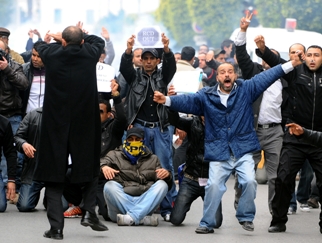
Algerian protesters chant slogans during a demonstration in Algiers Photo: EPA
Plastic bullets and tear gas were used to try and disperse large crowds in major cities and towns, with 30,000 riot police taking to the streets in Algiers alone.
There were also reports of journalists being targeted by state-sponsored thugs to stop reports of the disturbances being broadcast to the outside world.
But it was the government attack on the internet which was of particular significance to those calling for an end to President Abdelaziz Boutifleka's repressive regime.
Protesters mobilising through the internet were largely credited with bringing about revolutions in Egypt and Tunisia.
"The government doesn't want us forming crowds through the internet," said Rachid Salem, of Co-ordination for Democratic Change in Algeria.
"Security forces are armed to the teeth out on the street, and they're also doing everything to crush our uprising on the internet. Journalists, and especially those with cameras, are being taken away by the police." President Hosni Mubarak had tried to shut down internet service providers during 18 days of protest before stepping down as Egyptian leader on Friday.
Mostafa Boshashi, head of the Algerian League for Human Rights, said: "Algerians want their voices to be heard too. They want democratic change.
"At the moment people are being prevented from travelling to demonstrations. The entrances to cities like Algeria have been blocked."
At least five people were killed in similar protests in Algeria in January, when the Interior Ministry said 1000 people were arrested.
On Saturday at least 500 had been arrested by early evening in Algiers alone, with hundreds more in Annaba, Constantine and Oran taking part in the so-called February 12 Revolution.
"The police station cells are overflowing," said Sofiane Hamidouche, a demonstrator in Annaba.
"There are running battles taking place all over the city. It's chaos. As night falls the situation will get worse."
Algeria has the eighth largest reserves of natural gas in the world, and is also oil-rich, but its youthful population suffers mass unemployment, a chronic lack of housing, and widespread poverty. Political corruption is also endemic.