Monday, 15 December 2014

Discussion topic for 16/12 'How important is a healthy diet?'

Shift workers 'sicker and fatter'


Health Survey for England data showed they were in worse health despite often being young.
The lead researcher told the BBC that the rise of zero-hours contracts may be increasing the numbers doing shift work and could raise "pretty serious problems" for the nation's health.
Scientists said it was "fairly clear now" that shift work was unhealthy.
The report, by the Health and Social Care Information Centre, showed 33% of men and 22% of women of working age were doing shift work.
They defined shifts as employment outside 0700-1900.
Rachel Craig, the research director for the Health Survey for England, told the BBC: "Overall, people who are doing shift work are not quite as healthy as their counterparts doing regular working hours."
The data showed 30% of shift workers were obese, compared with 24% of men and 23% of women doing normal hours.
Meanwhile, 40% of men and 45% of women on shifts had long-standing health conditions such as back-pain, diabetes or chronic obstructive pulmonary disease compared with 36% and 39% of the rest of the population.
Younger people
Shift working is most common in the 16-24 age group with nearly half of men and a third of women having this working pattern.
The rates fell with age so that fewer than a third of men and a fifth of women were working shifts after the age of 55.
Ms Craig said that, overall, young people should be in better health: "You'd expect less ill-health and fewer long-standing conditions that reflect lifestyle like obesity, so it makes it an even stronger relationship [between shifts and poor health]."
There is mounting scientific evidence on how disrupted sleep affects the normal rhythms of the body clock and leads to a wide-range of diseases.
However, other factors that are at play include people from lower incomes, who already have higher rates of poor health, being more likely to do shifts.
On the rise
Ms Craig raised concerns that the situation was getting worse.
She told the BBC News website: "It looks as though shift working is slightly higher than in 2009 and that may be a move to more part-time and zero-hours contract working. There is evidence to suggest that may be having an influence.
"It potentially does raise pretty serious problems and throws a challenge to employers to support shift workers and come up with ways to mitigate the effect of working shifts.
"If a larger proportion of people are doing shifts it is likely to result in greater demand on healthcare systems. It is something to think seriously about."
Dr Simon Archer, a body clock scientist at the University of Surrey, said the data was fascinating.
He said teenagers and young adults were generally more "evening-type" people as their body clock runs later.
He suggested this might explain why there were more young shift workers: "The young people are coping, but they shift more to 'morningness' as they get older and they can't hack it."
He added that smoking is also more common in evening-types, also known as owls, which was reflected in the health survey data.
He told the BBC News website that shifts were bad for the body: "The body isn't designed to eat in the night. It doesn't clear fat very well and shift workers tend to want to eat high calorie foods and that translates into things not so good for you.
"Obesity is the clear link, and that also leads to type-2 diabetes.
"Shift work is becoming increasingly common and it's causing a lot of problems to a lot of people and in particular the link with cancer is becoming stronger." 
http://www.bbc.com/news/health-30449818?print=true

Friday, 12 December 2014

Discussion article for 16/12

The $6.5m canyon: it's the most expensive photograph ever – but it's like a hackneyed poster in a posh hotel 


Photography is not an art. It is a technology. We have no excuse to ignore this obvious fact in the age of digital cameras, when the most beguiling high-definition images and effects are available to millions. My iPad can take panoramic views that are gorgeous to look at. Does that make me an artist? No, it just makes my tablet one hell of a device.
The news that landscape photographer Peter Lik has sold his picture Phantom for $6.5m (£4.1m), setting a new record for the most expensive photograph of all time, will be widely taken as proof to the contrary. In our world where money talks, the absurd inflated price that has been paid by some fool for this “fine art photograph” will be hailed as proof that photography has arrived as art.
Yet a closer look at Phantom reveals exactly the opposite. This record-setting picture typifies everything that goes wrong when photographers think they are artists. It is derivative, sentimental in its studied romanticism, and consequently in very poor taste. It looks like a posh poster you might find framed in a pretentious hotel room.
Phantom is a black-and-white shot taken in Antelope Canyon, Arizona. The fact that it is in black and white should give us pause. Today, this deliberate use of an outmoded style can only be nostalgic and affected, an “arty” special effect. We’ve all got that option in our photography software. Yeah, my pics of the Parthenon this summer looked really awesome in monochrome.
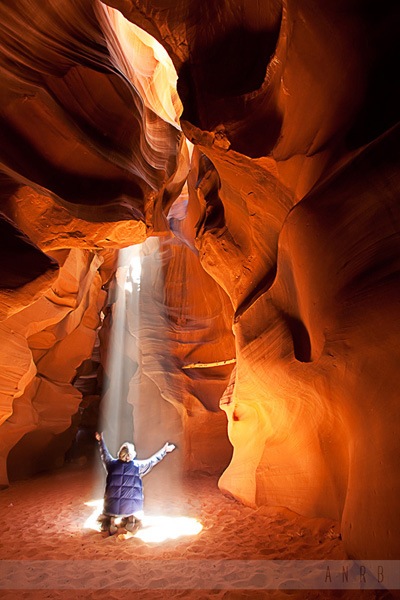
Lik’s photograph is of course beautiful in a slick way, but beauty is cheap if you point a camera at a grand phenomenon of nature. The monochrome detailing of the canyon is sculptural enough, and a shaft of sunlight penetrating its depths becomes the phantom of the title. Yet, in fact, this downward stream of light is simply a natural aspect of Antelope Canyon. Look it up online and you will find avast range of photographs that all show the same feature. They are all just as striking as Phantom. The photographer has added nothing of any value to what was there already. Google is full of “great” pictures of this awe-inspiring natural feature.
Advertisement
Someone has been very foolish with their money, mistaking the picturesque for high art.
As a colour picture without any arty claims, this would be a valuable record of nature. Instead, it claims to be more than that; it aspires to be “art”. It is this ostentatious artfulness that pushes it into the realm of the false. For the artistic ambition of this picture is so very derivative from paintings that were created more than a century ago. Just like the very first “art” photographers in the Victorian age, Lik apes the classics in order to seem classic.
Phantom aims for the sublime, that sense of awe in front of nature that was described by Edmund Burke in the 18th century and taken to lavish heights by painters in the 19th. American painters especially, such as Frederic Edwin Churchand Albert Bierstadt, used a heightened romantic style to express the grandeur and amazement of the American landscape. Later, Georgia O’Keeffe added a surreal dreaminess to the west’s iconography. Film-makers, above all John Ford, were influenced by the American landscape painters when they put the west on screen.
Phantom comes along in the wake of all these representations of the American landscape in art – and lazily emulates them. It is a cliche: easy on the eye, easy on the brain, hackneyed and third-hand.
If this is the most valuable “fine art photograph” in history, God help fine art photography. For this hollow and overblown creation exposes the illusion that lures us all, when we’re having a good day with a good camera – the fantasy that taking a picture is the same thing as making a work of art.

http://www.theguardian.com/artanddesign/jonathanjonesblog/2014/dec/10/most-expensive-photograph-ever-hackneyed-tasteless?CMP=fb_gu

Monday, 24 November 2014

Conversation topic for 25/11 Should countries be held liable for nuclear testing?

French Polynesia: Billion dollar nuclear claim


An overseas territory governed by France is to ask Paris for nearly $1bn in compensation for damage caused by nuclear weapons tests, it's been reported.
The assembly of French Polynesia, based in Papete, has prepared a demand for $930m (£594m) over the 193 tests carried out by France in the South Pacific between 1966 and 1996, Radio New Zealand International reports. The ruling Tahoeraa Huiraatira party, which opposes independence from France, is also demanding an additional $132m for the continued occupation of a pair of atolls used for nuclear testing but which still not been returned.
French Polynesia is a territory comprising more than 100 islands and atolls with its own government, but is still part of the French Republic. At the end of French nuclear testing in 1996, former Polynesian president Gaston Flosse negotiated a $150m annual payment to support the country's economy.
The billion-dollar claim is not universally popular in Papete. Current president Edouard Fritch said he was unaware of the assembly's demand and was "disappointed" at plans to ask Paris for the money, Radio New Zealand reported.
Source: http://www.bbc.com/news/blogs-news-from-elsewhere-30175925?print=true